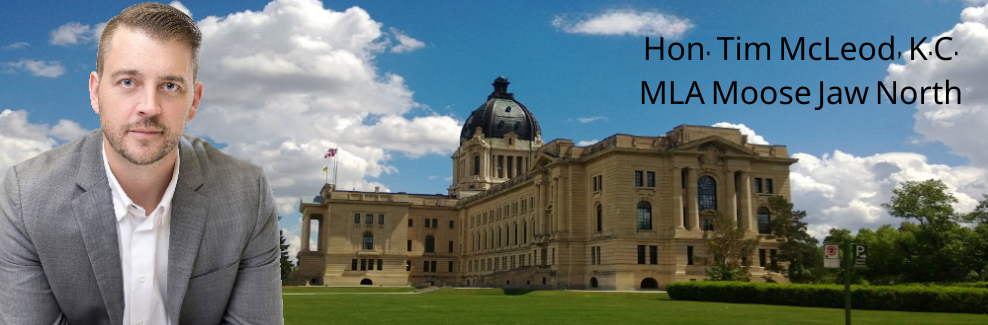
Motion of Privilege (29 April 2026)
To view this section on video, click here and start play at 2:59:35 PM.
Privilege Motion
Hon. Tim McLeod: — Thank you very much, Mr. Speaker. Mr. Speaker, I will make some brief remarks at the close of which I will be moving the motion that accompanied my letter to you on April 27th. And I will be asking my fellow members to support that motion.
Mr. Speaker, we are all hon. members of this Assembly which is why I rise today, not with pleasure but rather with disappointment, that one among us has breached privilege.
As the members of this House know, Mr. Speaker, a breach of privilege in this place is considered one of the most egregious violations by a member. We all speak frequently about what an honour it is to be here, what an honour it is to stand in our place to be recognized as a representative of our communities to address this Assembly.
We use that word deliberately, Mr. Speaker — honour. It’s more than just a word. In order to be meaningful it requires corresponding action. Our behaviour in this place and our conduct in the exercise of our duties to the people that we serve, that behaviour matters, Mr. Speaker.
We have clear rules and procedures that have been developed over time with purpose and for a good reason, and as hon. members we are all required to follow those rules. We don’t have the luxury of picking which ones apply or which ones can be ignored. And certainly none of us is entitled to say that we are above those rules. Yet here we are, Mr. Speaker.
You have found a prima facie case that the member from Cumberland has breached privilege, your privilege no less, Mr. Speaker. That amounts to contempt of this House.
I’ll quote House of Commons Procedure and Practice, Fourth edition, 2025 at page 54, paragraph 3.11 where it reads:
Any disregard of or attack on the rights, powers and immunities of the House and its members . . . is referred to as a “breach of privilege” and is punishable by the House.
That same paragraph goes on to say:
. . . the House also claims the right to punish, as a contempt, any . . . [act] or omission which, though not a breach of a specific privilege, tends to obstruct or impede the House in the performance of its functions, obstructs or impedes any member or officer of the House in the discharge of their duties, or is an offence against the authority or dignity of the House.
And finally it says:
A contempt does not have to actually obstruct or impede the House or a member; it merely has to have the tendency to produce such results. In that sense, all breaches of privilege are contempts of the House.
Mr. Speaker, there is no honour in having to withdraw a comment or apologize for it. It’s not something to laugh about or take any pride in. There is no honour in violating the rules of this Assembly. And there is certainly no honour in breaching privilege and committing contempt of this House, which brings us to where we are today, Mr. Speaker.
As your prima facie case ruling in this case has established, the member from Cumberland has shown a regular pattern of disregard or disrespect for the Chair. He has frequently ignored rulings of the Speaker, sometimes multiple times per day for multiple days in a row. He has consistently ignored the boundaries of what is appropriate behaviour in this place. And, Mr. Speaker, that member last week went too far.
He carried that inappropriate behaviour outside the Chamber. He called a press conference and distributed a letter to the media demanding that you violate the privileges of another hon. member of this House. But it didn’t stop there. Seemingly in an effort to capitalize on what they saw as a political opportunity, that member in the NDP caucus published an attack-style infographic on their social media using your image, Mr. Speaker, to demand that you release confidential information of another hon. member.
The member from Cumberland also recorded and published a video that was posted on his and other members of the NDP caucus’s social media, where he again called upon you to violate the privileges of another hon. member of this House as though he was entitled to it, Mr. Speaker. All of this was done after the letter had been sent to you and before you had had a chance to address that letter, in what appears to be an attempt to apply public and political pressure to your office.
Again, Mr. Speaker, it is contempt of this Assembly to “obstruct or impede . . . [a] member or officer of the House in the discharge of their duties.”
Mr. Speaker, I will quote from Beauchesne’s paragraph 167, which speaks to the unique role of your role in both parliamentary convention and in academic text. I quote:
The Presiding Officer, while but a servant of the House, is entitled on all occasions to be treated with the greatest attention and respect by the individual Members because the office embodies the power, dignity, and honour of the House itself.
Mr. Speaker, in order to preside over the activities of this Assembly, as you well know and have carried out with great dignity, the impartiality of the Chair must not be put into question, ever.
I’ll again quote from Beauchesne’s, this time at 168, subparagraph 1:
Confidence in the impartiality of the Speaker is an indispensable condition of the successful working of procedure, and many conventions exist which have as their object, not only to ensure the impartiality of the Speaker but also, to ensure that there is a general recognition of the Speaker’s impartiality.
And finally, Mr. Speaker, Beauchesne’s, paragraph 71, to maintain the impartiality of the Speaker and give due respect to its role, it says, “The Speaker should be protected against reflections on . . . [their] actions.”
These are serious matters and ought not be viewed lightly, Mr. Speaker. As hon. members, we need to behave honourably. And should the Speaker ever find that one of us has run afoul of the rules, that member ought to demonstrate remorse and humility, acknowledging their wrongdoing, and hopefully altering their behaviour moving forward, to show greater respect for their fellow members, for this institution, and especially towards the Speaker as the Chair of this Assembly.
With that, Mr. Speaker, I will move the following motion:
That the actions of the member for Cumberland on April 22, 2026, constitutes a breach of privilege of the Speaker of the Legislative Assembly of Saskatchewan resulting in contempt by attempting to influence a decision of the Speaker, and by publicly requesting the Speaker violate the privilege of another member of the Legislative Assembly of Saskatchewan.
That the member from Cumberland apologize to the Speaker and the Assembly for his actions and remove any social media posts containing a letter and infographic.
I so move, Mr. Speaker.
Back to 2025/2026 Session

Constituency Office
Constituency Assistant: Jacqui Stephens
200 – 99 Diefenbaker Drive
Moose Jaw, SK S6J 0C
Telephone: (306)-692-8884
Fax: (306)-693-3251
Email: mjnorthmla@sasktel.net
Hours of Operation:
Monday to Friday from 8:30 to 12:00 and 12:30 to 4:00